

Canada is not on track to reduce its emissions by 50% from 2020 levels by 2030 or to become carbon neutral by 2050.
Canada ratified the Paris Agreement on October 5, 2016. National inventories of greenhouse gases (GHGs) are submitted to the UNFCCC annually by April 15 of each year. The following data are taken from the April 14, 2026 submission. In 2024 (most recent data), Canada’s GHG emissions (excluding the Land Use, Land-Use Change and Forestry [LULUCF] sector) were 685 megatonnes of carbon dioxide equivalent (Mt CO2eq), a decrease of 78 Mt (-10%) from the 2005 baseline, and a decrease of 2.2 Mt (-0.3%) from revised 2023 emissions. The largest emissions-producing sector remains energy use. Ongoing increases continue due to considerable expansion in Canada’s oil sands. The smallest sector generating emissions is waste from the treatment and disposal of liquid and solid wastes.
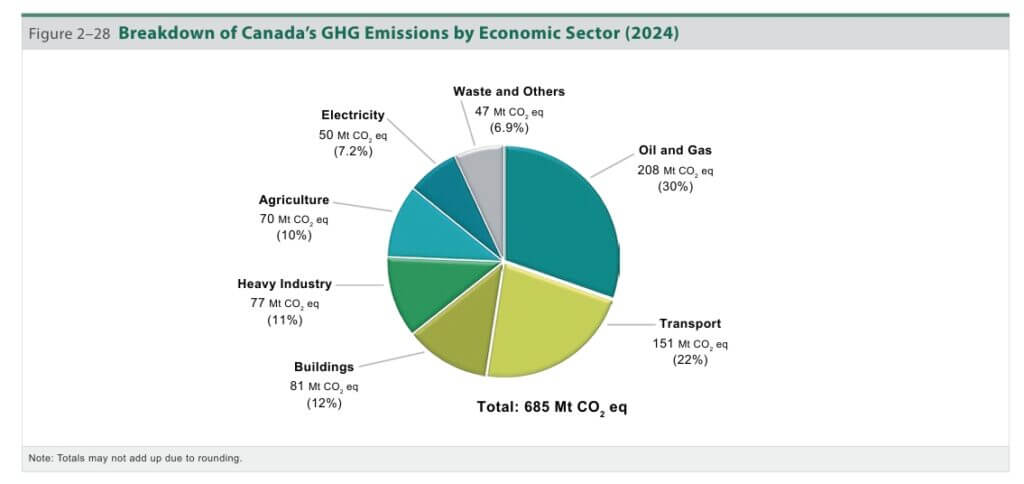
In 2005, Canada’s GHG emissions were 747 Mt CO₂ eq. Notable trends between 2005 and 2024 were a) electricity emissions that decreased by 66 Mt (-57%) driven by a phase-out of coal-fired electricity generation and increased use of renewable sources and b) oil and gas emissions that increased by 10 Mt (5.1%). Methane emissions reached their lowest level in 2024 at 105 Mt CO2 eq, down 47 Mt (31%) from 2005, largely due to federal and provincial methane-reduction regulations.
Canada’s GHG emissions in 2016 were 704 Mt CO₂ eq. Between 2016 and 2024, Canada reduced its GHG emissions by approximately 10% below 2005 levels, by 59 Mt or 7.9%. Since 2015, significant decreases have occurred in Oil and Natural Gas fugitive sources (-33 Mt, or -34%) and in the Electricity sector (-25 Mt, or -31%). In contrast, Oil and Gas Extraction combustion emissions increased by 12 Mt (12%), mainly attributed to continued production growth in Canada’s oil sands operations. Transport emissions increased as well, notably Light-Duty Gasoline Trucks by 6.2 Mt (13%) and Other Transportation by 3.4 Mt (6.8%), coinciding with increased pipeline transport of natural gas.
Long-term emission trends were marked by the COVID-19 pandemic (2020, 2021), resulting in an abrupt decrease of 67 Mt (9.0%) in total GHG emissions between 2019 and 2020, with almost half of this decrease from Transport (-32 Mt or -15%). The following year, emissions increased slightly by 10 Mt (1.5%), and between 2021 and 2022 there was a continued increase of 4.5 Mt (0.7%), while remaining below 2019 pre-pandemic levels. Finally, between 2022 and 2024, GHG emissions decreased by 11 Mt (1.6%). The impacts of the pandemic are now harder to distinguish in recent years.
Canada is not on track to reduce its emissions by 50% from 2020 levels by 2030 or to become carbon neutral by 2050. Canada’s emissions reduction target is 45-50% below 2005 levels by 2035, not 2030. Following the April 28, 2025, Canadian election, a Liberal minority government has set its goal of improving economic resilience through pragmatic environmental policies that boost, rather than hinder, economic activity while navigating trade turbulence.
Prime Minister Carney has stated this more than once, most recently in late June, that near-term climate benchmarks are out of reach and that emissions will be higher in the coming years than projected.
Carney has explicitly declared that his government won’t curb growth in the oil and gas sector to meet these targets. He argues the previous government’s strict climate framework was too expensive and divisive. His administration has canceled the consumer carbon tax, EV sales mandates, and the cap on oil and gas emissions. It has allowed natural gas as part of the national electricity strategy. His updated energy strategy prioritizes economic affordability, reliable conventional energy exports to allies, and low-carbon infrastructure investments. He defends this pivot by emphasizing that Canada must secure its energy independence and unify the country’s economic interests amid ongoing geopolitical instability.
The greatest impediment to making greater reductions in emissions is the oil and gas sector, whose emissions continue to rise, compounded by jurisdictional tensions between federal and provincial governments, particularly regarding natural resource management and carbon pricing rollbacks. For example, the push for infrastructure expansion included partnering with Alberta on initiatives such as carbon capture and new oil pipelines. Canada’s Parliamentary Budget Office states that Canada’s current projected emissions for 2030 are 31.5% to 33.5% below 2005 levels.
This Post was submitted by Climate Scorecard Canada Country Manager, Diane Szoller.
Learn More Resources
Canada’s Office of the Parliamentary Budget Officer – Estimating Canada’s 2030 Emissions Gap
Government of Canada – Greenhouse gas emissions
United Nations Climate Change – National Inventory Submissions 2026
YouTube – Carney Concedes – https://www.youtube.com/watch?v=3cwrmbGfnqM