Turkey has been very dependent on Russian natural sources for energy. Russia has been the major supplier of natural gas for Turkey through the pipelines crossing Black Sea and Eastern Europe. Turkey is importing over 60 billion m3 of natural gas mostly from Russia and partly from Algeria and Nigeria as LNG. Significant amount of...
Category: Turkey News Brief and Action Alert
Turkey: Climate Progress Report
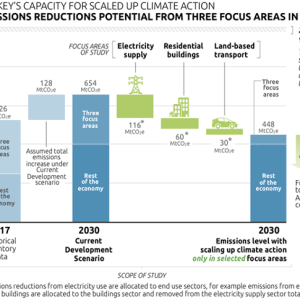
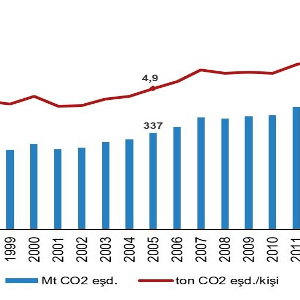
Turkey would need to reduce its emissions to below 365 MtCO2 by 2030 and to below 226 MtCO2 by 2050 to be within its emissions allowances under a ‘fair-share’ range compatible with global 1.5°C. Turkey’s intended 2030 national emissions reduction target is to reduce emissions 21% below what it calls a business-as-usual scenario, equivalent to...
Climate Justice in Turkey
HIGHLIGHTS A drop in agricultural productivity and a rise in food prices Rising energy prices for those who can’t afford them Decline in welfare and living standards of low-income communities NARRATIVE Climate change will affect different people and places unevenly and is likely to lead to inequalities within and across nations, and between current...
Turkey: The 2021 Climate Year in Review
HIGHLIGHTS Devastating Forest Fires Unusually Heavy Storms and Rain in the North Eastern Provinces Increased Use of Coal for Domestic Heating The Share of Renewable Energy in Installed Energy Capacity Reached 53% Turkish Parliament Ratified the Paris Climate Agreement NARRATIVE 2021 has been a very challenging year for Turkey regarding the climate and emission...
Climate Mitigation Strategic Priorities for Turkey
Priorities Extend Renewable Energy Investment Incentives Increase Research in Improving Energy Storage Facilities Increase Support for Electric Vehicles, Charging Stations and Rail Cars End Waivers for the Enforcement of Industry Emission Standards Explore Price Controls for the Household Use of Natural Gas Narrative Turkey joined the U.N. Framework Convention on Climate Change in 2004...
Climate Scorecard Progress Report for Turkey
This report is in the form of memos from Climate Scorecard Country Managers to Patricia Espinosa, Executive Secretary of the United Nations Framework to Combat Climate Change (UNFCCC). Below is a description of the progress the country has made made in mitigating greenhouse gas emissions since the Paris Agreement was signed in 2015 and the...
Centralized Emission Data Processing in Turkey
This Post was submitted by Climate Scorecard Turkey Country Manager Dr. Semih Ergur Best Organizational Source: The Climate Change and Weather Control BoardTurkey has three institutions, namely “General Directorate of Environmental Control” under the “Ministry of Environment and Urbanization” and “State Water Works and General Directorate of Meteorology”, under the “Ministry of Agriculture and...
Extreme Temperatures and Forest Fires in Turkey Reflect Climate Change
This Post is submitted by Climate Scorecard Turkey Country Manager Semih Ergur Turkey’s land mass is an area of 770,000 km2 extending from Caucasus to Thrace situated between the Black Sea, Aegean Sea, and Mediterranean Sea with its highest altitude reaching 5150 m. Although the weather conditions vary from region to region, there are...
Turkey Moves to Construct it’s First Nuclear Power Plants
This Post was submitted by Climate Scorecard Turkey Country Manager Semih Ergur The installed capacity of electricity generation industry in Turkey—utilizing all kinds of sources—is around 95000 MW. Of this capacity, 27% is Combined Cycle Natural Gas Power Plants (CCNG PP), 21% is coal fired power plants, 32% is hydro, 10% wind, 8% solar, and...
Turkey: Lack of 2030 and 2050 Emissions Reduction Plans and a Fossil Fuel Centered COVID Economic Recovery Plan
This post was submitted by Turkey Country Manager Barış Can Sever Turkey lacks a plan for reducing 2030 and 2050 emissions levels. It has signed but not yet ratified the Paris Agreement. Its NDC pledge is 21% below current Business as Usual levels. There is an absence of any climate action plans for reducing emissions...