This report is in the form of memos from Climate Scorecard Country Managers to Patricia Espinosa, Executive Secretary of the United Nations Framework to Combat Climate Change (UNFCCC). Below is a description of the progress the country has made made in mitigating greenhouse gas emissions since the Paris Agreement was signed in 2015 and the...
Category: Saudi Arabia News Brief and Action Alert
International Agencies Are the Best Sources of Emissions Data for Saudi Arabia
This Report was submitted by Climate Scorecard Saudi Arabia Country Managers Abeer Abdulkareem and Amgad EllaboudyBest Organizational Source: ARAMCO Many of the publicly available, official figures for Saudi Arabia carbon emissions come from international organizations such as the World Bank, United Nations, and International Energy Agency. However these organizations most likely rely on gathering...
Saudi Arabia Experienced Unusually Heavy Rainfall Events in 2021
This Post was submitted by Climate Scorecard Saudi Arabia Country Managers Abeer Abdulkareem and Amgad Ellaboudy Saudi Arabia has experienced three heavy rainfall events, with one being particularly deadly during 2021. On February 6 of this year, heavy rains fell on Tabuk Province in northwest Saudi Arabia causing street flooding; several people were trapped...
Saudi Arabia Sees Nuclear Energy In Its Future
This Post was submitted by Climate Scorecard Saudi Arabia Country Managers Abeer Abdulkareem and Amgad EllaboudySaudi Arabia’s nuclear energy use Saudi Arabia currently does not rely on nuclear power at all for its energy use. Although it has been planning to implement nuclear energy for a few decades now, it fulfills its energy needs mainly...
Continued Dependence on Fossil Fuels in Saudi Arabia and the Lack of a Feasible Plan to Increase Renewable Energy
This Post was submitted by Climate Scorecard Saudi Arabia Country Managers Abeer Abdulkareem and Amgad Ellaboudy The biggest challenge for implementing the policy of increased Renewable Energy Capacity Program include continued dependence on fossil fuels energy sources and the small share of renewable energy in the nation’s total energy consumption. The majority of Saudi...
Saudi Arabia’s CO2 Emissions Have Increased Over 3x Since 1990
This Post was submitted by Climate Scorecard Saudi Arabia Country Managers Abeer Abdulkareem and Amgad EllaboudySaudi Arabia’s most current carbon dioxide emission number sits at 582.1 million tons per year, as of 2019. This is more than a threefold increase from its baseline emissions in 1990 of 185.5 million tons per year. Saudi’s share of...
King Abdullah University of Science and Technology: A Model Sustainable Mini-City
This Post was submitted by Climate Scorecard Saudi Arabia Country Managers Abeer Abdulkareem and Amgad Ellaboudy King Abdullah University of Science and Technology (KAUST) is a model of a mini-city that has climate-conscious plans and programs and has earned a Platinum rating on the Leadership in Energy and Environmental Design (LEED) scale. KAUST is...
Sakaka Solar Plant and Dumat al-Jandal Wind Farm in Saudi Arabia
By Climate Scorecard Saudi Arabia Country Managers Abeer Abdulkareem and Amgad Ellaboudy Most of the renewable energy projects in Saudi Arabia are either at the tender-bidding, construction and installation, or production trial phases. Therefore, it is too early to elicit the best practices in the production or distribution of renewable energy projects in the...
Climate Policy Recommendation: Strengthen Saudi Arabia’s Renewable Energy Program
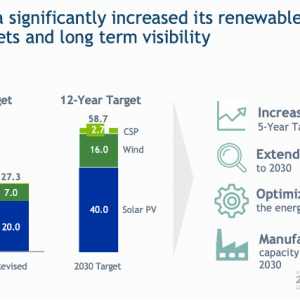
Policy Recommendation: Strengthen Saudi Arabia’s Renewable Energy Program The Kingdom of Saudi Arabia can achieve a noticeable reduction in its greenhouse gas (GHG) emissions if it fully implemented the Saudi Arabia National Renewable Energy Program. Initially, Saudi Vision 2030’s target was to achieve 9.5 GW of renewable energy generation by 2030. This goal has been...
Saudi Arabia’s National Grid Still Largely Fueled by Carbon-Intense Energy Sources
Saudi Arabia’s electricity is primarily composed of fossil fuel sources—particularly natural gas and crude oil—with a small but increasing amount from solar energy. For its electricity, the Kingdom sources 218,470 Gigawatt hours (GWh) (or 60%) from natural gas, 159,528 GWh (or 40%) from crude oil, and 155 GWh (or < 1%) from solar energy. In...