

To keep the network stable when solar output drops or wind speeds shift, utilities will need to mandate advanced technical interventions.
Japan’s electricity grid presents a striking paradox. On one hand, it is a masterclass in everyday engineering resilience. According to recent data from the country’s cross-regional grid monitor, the Organization for Cross-regional Coordination of Transmission Operators (OCCTO), 2026, the typical low-voltage household lost power for an average of just 24 minutes over the entire last fiscal year. Meanwhile, the system carries a century-old technical divide. The main islands are split by an invisible historical border: eastern Japan operates at 50 hertz, while central and western Japan operate at 60 hertz.
In an era defined by localized fossil fuel generation and predictable demand centers, the frequency divide mattered less. Today, it has become a more important constraint. As large solar installations in Kyushu and wind development in Tohoku add renewable electricity to the system, moving power efficiently between regions matters more. Crossing the 50/60-hertz boundary requires frequency conversion infrastructure, limiting how freely electricity can move between eastern and western Japan. Power cannot flow freely; it must be squeezed through a handful of expensive, high-voltage direct current (HVDC) frequency conversion stations. This infrastructure was built to serve the localized utilities of the 20th century, and it is visibly buckling under the weight of a modern, nationwide green energy transition.
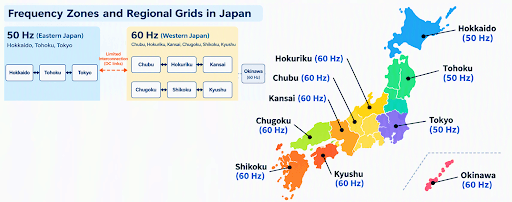 Figure 1. Simplified structure of Japan’s regional electricity grid and the 50Hz/60Hz frequency divide—source: OCCTO.
Japan’s power system is divided into 10 regional grids, with a 50 Hz/60 Hz split between the east and west. These grids are interconnected, but cross-frequency links are limited.
While Japan’s daily reliability numbers remain impressive, maintaining that benchmark is getting harder. The margin for error is shrinking, driven by a volatile mix of climate realities and hardware vulnerabilities. OCCTO’s tracking revealed that while ten major supply disruptions were traced back to facility failures or routine maintenance deficits, four high-consequence outages were triggered directly by natural disasters. From severe summer rainstorms paralyzing parts of Tokyo to aggressive typhoons battering western networks, localized grids are being forced to absorb immense physical shocks.
However, the ultimate test for Japan’s grid isn’t just surviving the next storm. It is keeping up with a new wave of electricity demand. The government’s latest strategic roadmaps point to rising power consumption driven by high-density data centers, semiconductor fabrication plants, and broader industrial electrification. This digital boom is arriving just as the generation mix becomes highly variable.
Independent academic modeling indicates that the grid can technically accommodate an ambitious surge in wind and solar capacity. The catch is that operators must evolve past legacy balancing methods. To keep the network stable when solar output drops or wind speeds shift, utilities will need to mandate advanced technical interventions. This includes soliciting fast frequency response (FFR) directly from renewable developers to simulate system inertia, alongside deploying large-scale battery storage.
To complicate matters, “grid security” has fundamentally changed. It is no longer just a game of cutting back tree branches and reinforcing steel towers. It is digital. Because a smarter, more dynamic grid relies heavily on automated software and interconnected communications, the threat landscape has migrated online. Recognizing this vulnerability, the Ministry of Economy, Trade and Industry (METI) rolled out strict supply chain security mandates targeting power control systems. A weakness in software or the supply chain can now become a grid reliability problem even when the physical infrastructure itself is functioning normally.
Japan’s regional network structure is not an inherent weakness. It provides a foundation for deeply experienced regional operators. The problem is timing. The system was never engineered to manage surging digital demand, a rapidly changing generation mix, growing climate risks, and sophisticated cyber threats simultaneously. Japan has already begun upgrading its networks and rewriting its market rules. Still, the country’s next great infrastructure challenge will be whether those changes arrive quickly enough to keep a historically reliable grid reliable through the energy transition.
This Post was written by Climate Scorecard Japan Country Manager, Delmaria Richards.
Learn More Resources
1. Agency for Natural Resources and Energy. (2022, April 28). Here’s more about the 6th Strategic Energy Plan: Efforts to overcome “grid constraints” toward expanding the introduction of renewable energy.
○ Link: https://www.enecho.meti.go.jp/en/category/special/article/detail_174.html
2. Agency for Natural Resources and Energy. (2026, March). Next-generation electricity system development: Interim summary [Japanese].
○ Link: https://www.meti.go.jp/shingikai/enecho/denryoku_gas/jisedai_kiban/pdf/20260317_2.pdf
3. Kuwahata, R., Merk, P., Wakeyama, T., Pescia, D., Rabe, S., & Ichimura, S. (2020). Renewables integration grid study for the 2030 Japanese power system. IET Renewable Power Generation, 14(8), 1249–1258.
○ Link: https://doi.org/10.1049/iet-rpg.2019.0711
4. Ministry of Economy, Trade and Industry. (2025, June 3). Guide to supply chain security measures for power control systems published.
○ Link: https://www.meti.go.jp/english/press/2025/0603_007.html
5. Organization for Cross-regional Coordination of Transmission Operators. (2026, January). Report on the quality of the electricity supply: Data for fiscal year 2024.
○ Link: https://www.occto.or.jp/en/assets/en/information_disclosure/report_on_the_quality/of_electricity_supply_data_for_fy2024/2024_qualityofelectricity_260113.pdf