Climate for Change https://www.climateforchange.org Climate for Change is an Australian climate engagement organisation founded in 2014. It describes itself as Australia’s first environmental organisation focused on helping people have conversations about climate change with people they trust. The organisation is an intergenerational and nonpartisan community that aims to turn concern about climate change into hope,...
Category: Australia News Brief and Action Alert
Australia: The Status of Solar and Wind Energy
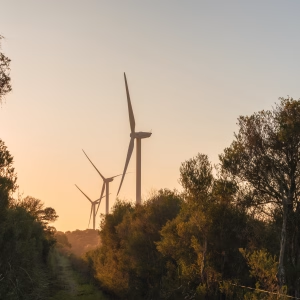
Wind and solar generation together exceeded coal and gas generation during several periods in late 2025, reflecting a major structural transition in the energy sector. Australia’s renewable energy system has expanded rapidly over the past decade, particularly in solar and wind power. As of early 2026, rooftop solar capacity has reached approximately 28.3 GW, while renewable...
Australia: Country Water Resources
Addressing climate change is critical to Australia’s future water supply. Mitigation efforts that limit global warming would reduce drought severity, slow evaporation losses, and improve water reliability for agriculture and communities.Australia is one of the driest inhabited continents on Earth, and water scarcity has long shaped its economy, communities, and politics. Over the past 30...
Australia: Plan to Phase Out Fossil Fuel by 2030
Phasing out fossil fuels by 2030 would mark a dramatic shift, not just in energy policy, but in national identity. It would align Australia with the goals of the Paris Climate Agreement and position it as a leader in the global transition away from fossil fuels.Australia’s Race to Quit Fossil Fuels by 2030 Australia sits...
Australia: 2026 Emissions Forecast
Australia’s emissions are expected to decline modestly by the end of 2026, continuing the downward trend seen in 2025.Australia’s emissions are expected to decline modestly by the end of 2026, continuing the downward trend seen in 2025. National emissions for the year to June 2025 fell by around 2.2%, and current policy and investment settings...
Australia: Climate Mitigation & Economic Development
Climate mitigation can support, rather than hinder, Australia’s long-term economic development if policies are more tightly integrated.Australia faces a clear policy tension between investing in climate mitigation and economic development. On the one hand, climate policy seeks accelerated reductions in emissions, the deployment of clean energy, and a transition away from fossil fuel dependence. On...
Australia: Sea Level Rise
AUSTRALIASea level around Australia has been rising, and the rate has accelerated in recent decades.The National Climate Risk Assessment (NCRA), released in September 2025, is Australia’s first nationally comprehensive assessment of climate change risks across systems such as communities, the economy, infrastructure, health, and the environment. It was prepared by the Australian Climate Service (a...
Australia: How To Reach The Hardest-To-Reach Climate Target Group
Lower- to middle-income households in regional and outer-suburban areas, particularly in coal and gas dependent regions.Who They Are The hardest group to engage in Australia’s climate transition are lower- to middle-income households in regional and outer-suburban areas, particularly in coal and gas-dependent regions such as the Hunter Valley (NSW), Central Queensland, and Gippsland (VIC). Many...
Australia: The Politics of Climate Change
There is a solid base of public support for climate action — especially among younger and urban Australians — but some fatigue, cost-sensitivity, and regional/industry-based pockets of resistance remain. Political Leadership The federal government is led by the Australian Labor Party (ALP), led by Anthony Albanese, which, since 2022, has signaled stronger climate ambitions...
Australia: Nuclear Energy Updates
Australia currently has no nuclear power generation.Australia currently has no nuclear power generation, relying instead on extensive, low-cost coal and natural gas reserves, alongside rapidly expanding renewable energy sources. The country’s only nuclear facility is the OPAL research reactor at Lucas Heights, which is used for the production of medical isotopes and research, rather than...