

The stark lesson of the last 20 years is that cutting emissions is vital to slow future extremes. Still, resilient, heavy-duty local infrastructure dictates how much damage Japan must endure along the way.
Japan’s weather has always been a complex mix of monsoons, typhoons, and sharp regional divides. Over the past two decades, however, those long-established patterns are beginning to shift. It is no longer accurate to describe the seasons simply as “hotter summers and warmer winters.” Instead, the country is facing unprecedented extreme heat, intense rainfall events, shrinking snowpacks across historic winter belts, and increasingly sharp swings between dry and wet conditions. According to the Japan Meteorological Agency, these shifts point directly to long-term climate warming rather than normal, year-to-year weather volatility.
The clearest sign of this shift is rising temperatures. Japan’s annual mean has climbed roughly 1.40°C per century since records began in 1898, with 2024 breaking the record as the warmest year in the baseline file. The future looks even more severe. Under a low-emission pathway, late-century temperatures will likely rise by 1.4°C compared to the end of the 20th century. If emissions remain high, that jump could hit 4.5°C, triggering a massive spike in days above 35°C and nearly wiping out freezing winter days.
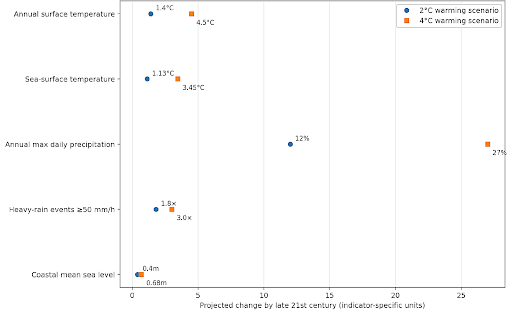
Figure 1. Selected projected late-21st-century climate changes for Japan under lower (2°C) and higher (4°C) global-warming scenarios—source: Japan Meteorological Agency, Japan’s Climate Change 2025.
Interestingly, Japan is seeing fewer rainy days overall, but when it does rain, the cloudbursts are far more intense. Days with over 100 mm of rain are steadily rising. Japan’s 2025 climate assessment warns that these events are expected to become significantly more frequent: hourly downpours exceeding 50 mm are projected to occur 1.8 times more often under a 2°C warming scenario, and three times more often if warming hits 4°C. The physics behind this is simple: warmer air traps more moisture. Climate researchers S. Nayak and T. Takemi recently confirmed that atmospheric water vapor over Japan scales up by about 7% for every 1°C increase on wet days, essentially supercharging modern rainstorms.
These models are already playing out in real time across public health and agriculture. Extreme summer heat is routinely pushing the medical system and the power grid to their limits. Between May and September 2024, Japan recorded 97,578 heatstroke emergency transports, marking one of the worst seasons on record. Meanwhile, standard crops are buckling under stress. Rice quality and general crop yields are increasingly compromised by a volatile mix of mid-summer heatwaves and sudden flash floods. Farmers are trying to adapt by shifting their traditional transplanting windows, but long-term warming trends threaten to make current agricultural heartlands entirely unsuitable for staple crops.
The financial toll on infrastructure is also escalating. The July 2018 heavy-rain disaster alone caused roughly ¥1.215 trillion in damage, making it one of the costliest flood disasters in Japanese history. Looking ahead, typhoons will likely bring heavier precipitation, and coastal sea levels are projected to rise between 0.40 and 0.68 meters by the end of the century, depending on global emissions. Even forest ecosystems are shifting; prolonged dry periods are drying out vegetation and creating unfamiliar, fire-prone conditions in regions historically insulated from severe wildfires.
The only real silver lining is a recent structural dip in Japan’s carbon footprint. National greenhouse gas emissions fell to 994 million tonnes of CO₂-equivalent in FY2024, down 28.7% from FY2013 levels, and for the first time, national output slipped below the one-billion-tonne threshold. This drop was driven by lower domestic manufacturing energy use and a cleaner grid, with renewable and nuclear energy combined now supplying over 30% of the power mix. To lock in this momentum, Tokyo has tightened its targets, aiming for a 60% emissions cut by FY2035 and 73% by FY2040, keeping its net-zero 2050 goal alive.
While expanding green energy and engineering heat-tolerant crops are steps in the right direction, the current pace of adaptation still lags behind the speed of changing weather. The stark lesson of the last 20 years is that cutting emissions is vital to slow future extremes. Still, resilient, heavy-duty local infrastructure determines how much damage Japan must endure along the way.
This Post was submitted by Climate Scorecard Japan Country Manager, Delmaria Richards.
Learn More Resources
Fire and Disaster Management Agency. (2025). Heatstroke emergency transport statistics and 2025 annual trend. https://www.fdma.go.jp/disaster/heatstroke/
Hasegawa, T., Ishigooka, Y., Nakazono, K., Sugiura, T., & Wakatsuki, H. (2025). Coping with climate change: An evaluation of agricultural impacts and adaptation in Japan. Springer. https://doi.org/10.1007/978-981-96-2436-2_4
Japan Meteorological Agency. (2025). Japan’s climate change 2025: Observation and projection assessment report. https://www.data.jma.go.jp/cpdinfo/ccj/2025/
Ministry of Land, Infrastructure, Transport and Tourism. (2020). 2018 flood damage statistics. https://www.mlit.go.jp/report/press/mizukokudo03_hh_001014.html
Ministry of the Environment. (2026). Japan’s national greenhouse gas emissions and removals in FY2024. https://www.env.go.jp/en/press/press_01760.html
Nayak, S., & Takemi, T. (2025). Regional and vertical scaling of water vapor with temperature over Japan during extreme precipitation in a changing climate. Scientific Reports, 15, 34826. https://doi.org/10.1038/s41598-025-22287-6