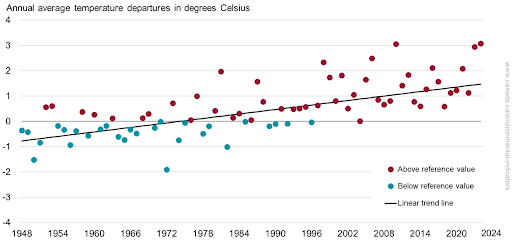
7 of Canada’s 10 warmest years on record have occurred within this two-decade window, accompanied by dramatic increases in weather whiplash (rapid shifts between opposing weather states such as severe drought to intense flooding) and catastrophic wildfire seasons.
Over the last 20 years, Environment and Climate Change Canada (ECCC) reports that Canadian weather has shifted markedly, driven by accelerated warming at roughly double the global rate. However, patterns differ, with northern regions experiencing triple that rate. 7 of Canada’s 10 warmest years on record have occurred within this two-decade window, accompanied by dramatic increases in weather whiplash (rapid shifts between opposing weather states such as severe drought to intense flooding), and catastrophic wildfire seasons.
The graph attached compares how much the temperature for a given year departs from the “normal”. The indicator shows the national annual and seasonal air temperature departure for the years 1948 to 2024. It also shows temperature departures for 2024 and temperature changes since 1948 by region.
Climate Data Canada indicates future projections point to intensified heat waves, more frequent extreme weather events, shorter winters, severe flooding, and shifting seasonal precipitation. This is driving higher insurance payouts as infrastructure strains. Predictive data comes via advanced national modeling and climate datasets. For example, to produce its Canada Change Climate report, the report used a foundational federal assessment that details quantitative future warming scenarios based on varying global emissions trajectories.
Temperature is a key indicator of how the climate changes in response to greenhouse gas emissions (GGE) from human activities, as rising emissions concentrations warm the Earth. The Canadian Climate Institute (CCI) confirms Canada’s total GGE in 2024 hovered near 685 Mt CO₂ eq. The oil and gas (30%) and transportation (22%) sectors drive these totals. A warming climate accelerates extreme events such as record wildfires, severe floods, crop disruptions, and shifts in per capita energy demand across the country. Temperature change can affect crops, forests, infrastructure, human health, disease spread, water availability, and ecosystem health. Warming temperatures increase risk of abrupt and/or irreversible impacts on ecosystems and the climate system. For example, CCI notes that northern permafrost thaw and unpredictable sea ice are disrupting northern communities and winter roads.
World Weather Attribution reported that Canada’s worst wildfire season on record, 2023, meant climate change more than doubled the likelihood of extreme fire weather conditions (high temperatures, low humidity, and drought) in Eastern Canada. It also made Québec’s season 50% more intense, and heat waves made wildfires easier to start and spread by increasing the likelihood of lightning strikes, the primary cause of wildfires. Dried out vegetation has made fires more flammable. Canadian wildfires have also severely impacted air quality in Canada and the USA, with Air Quality Index values frequently exceeding safe levels. Smoke from U.S. fires has also crossed Canada’s borders.
Predicting future weather –
ECCC uses a hybrid AI weather forecasting model, the Global Environmental eMuLator (GEML), paired with traditional physics models to predict large-scale and severe weather patterns faster and further in advance. This improves emergency readiness and preparation time for high-impact weather while making 6-day forecasts as accurate as previous 5-day forecasts. Traditional models combine data from weather observations such as satellite data, weather balloons, and radar to simulate how the atmosphere will change over time, including temperature, wind, moisture, and precipitation.
Canada is actively implementing its National Adaptation Strategy to build climate resilience. Key actions include upgrading severe weather early warning systems (the WeatherCAN app and Rapid Extreme Weather Event Attribution system), developing a national flood insurance program, funding community disaster mitigation, particularly for First Nations and northern communities, updating building codes to withstand extreme heat, heavy rain, and high winds, and collaborating with Canada’s Council of Forest Ministers on a unified wildland fire strategy. Actions include investing in nature-based solutions, such as restoring salt marshes, expanding urban green spaces, and planting trees to manage urban heat islands and absorb floodwaters. Lastly, providing regional guidance and public data platforms like ClimateData.ca helps municipalities track data, create specialized “future weather files” for infrastructure and building simulations, and plan zoning, cooling centers, and emergency responses. These are important steps.
Learn More Resources
Environment and Climate Change Canada – Changes in Temperature, GEML
Climate Data Canada – Canada Change Climate report, National Adaptation Strategy
Canadian Climate Institute – Emissions, extreme weather events
World Weather Attribution – Climate impacts on fire weather conditions
Submitted by Diane Szoller, Climate Scorecard Canada Country Manager.