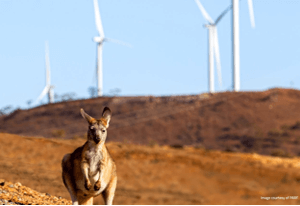
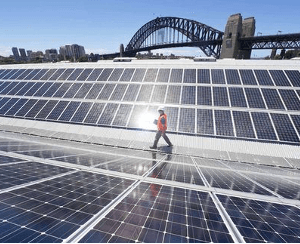
Post submitted by Australia Country Manager Julian Atchison The Asian Renewable Energy Hub The Asian Renewable Energy Hub (AREH) is one of two renewable energy export “mega-projects” currently in development in Australia. The full scope of the project makes for impressive reading; there will be 26GW installed wind and solar generating capacity (with a projected...
Category: Australia News Brief and Action Alert
Climate Policy Recommendations for Australia
Policy Recommendation #1: High-voltage Transmission Upgrades Policy Recommendation #2: A national Electric Vehicle Strategy that Supercharges EV Take-up Policy Recommendation #3: Use the Emissions Reduction Fund to Achieve Emissions Reductions Background Sadly, national-level discourse around climate change policy in Australia entered a new phase of “stupid” this month, with the National Party brazenly declaring agriculture...
Increased Consumption Demand in Australia Has Been Largely Met Through Gas and Renewable Energy
According to International Energy Agency statistics, Australia consumed 248 Terawatt hours (TWh) of electricity in 2018, up from 146 TWh in 1990. In 2019, official Australian government statistics broke down the electricity generation mix as follows: 56% coal, 21% gas, 21% renewable energy (solar, wind, and hydro), and 2% oil. As evidenced in the graph...
Australia’s Greenhouse Gas Levels Have Decreased 15% from 1990
Recently Reported Greenhouse Gas Level: 515 Mt in 2020, a Decrease of 15% from 1990 (Source: Australian Department of Industry, Science, Energy and Resources) The Australian government releases national emissions data on a quarterly basis. The latest release (for the April-June quarter of 2020) reports national emissions at 515Mt CO2 equivalents, a 3% drop from...
Big Leap Forward in the Renewables Sector and Continued Lack of Federal Response to Climate Needs in Australia
The July to October period has seen some incredible leaps in the Australian renewables sector despite lack of federal government support. The state of Tasmania is currently legislating a world-leading 200% renewable energy target. In October, South Australia became the first major jurisdiction in the world to be powered by 100% rooftop solar for any...
CSIRO and ARENA Leading Climate Mitigation Research in Australia
Australia has two major government-funded bodies leading on climate mitigation research: the Commonwealth Scientific and Industrial Research Organisation (CSIRO), and the Australian Renewable Energy Agency (ARENA). CSIRO’s mandate is broad, and the organisation is tasked with tackling Australia’s biggest future challenges by partnering with industry and universities. It has eight research units (with climate mitigation...
Green Job Opportunities in Australia Being Ignored By Current Government
Despite Australia’s status as the biggest exporter of fossil fuels in the world, there are relatively few Australian jobs in fossil fuel extraction. The “mining” sector – which covers coal and mineral ore mining, as well as oil and gas extraction – makes up only 1.9% (~250,000) of Australia’s labour force. But mining (and especially...
Australians Living on Low-Incomes Have the Fewest Protections from Climate Change Impacts
In 2013 the now-defunct National Climate Change Adaptation Research Facility raised the spectre of climate risks to disadvantaged Australians. Three heavily disadvantaged local government areas in the state of South Australia – Port Adelaide, Port Pirie and Berri – face the brunt of extreme weather events, rising temperatures, decreased rainfall and sea level rise but...
Retrofitting the Aluminium and Steel Industries in Australia
Even before COVID, Australia’s steel and aluminium manufacturing industries were at an interesting crossroads. Aluminium smelters in Australia currently operate at a massive financial loss and require significant government subsidies. Australian steel-making produces a relatively expensive product that often struggles for relevance in a crowded market. And, both have suffered from long-term uncertainty over climate...
Habitat Destruction in Australia is Accelerating, Making Way for Property Development and Agriculture
Australia is home to eight of the world’s fourteen different terrestrial habitats, with over one million unique species and thousands of distinct regional ecosystems. Around 20% of Australia’s landmass is protected under the National Reserve System (NRS): a framework introduced in 1992 to conserve Australia’s international status as a “region of mega-diversity”. Different regions provide...