

Over the past 30 years, climate change, demographic shifts, and evolving industrial demand have begun to reshape the security of Japan’s water supply, especially for agriculture and everyday household use.
Japan is often described as a water-rich country. With its steep mountain ranges, abundant rainfall, and more than 14,000 rivers, water has long been seen as a reliable resource. However, this perception is becoming more complex. Over the past 30 years, climate change, demographic shifts, and evolving industrial demand have begun to reshape the security of Japan’s water supply, especially for agriculture and everyday household use.
Changing Water Supply over the Last 30 Years
Since the 1990s, Japan’s hydrological patterns have become more variable. Although total annual rainfall has remained relatively stable, its distribution has changed. Rainfall now tends to occur in more intense bursts, followed by longer dry spells. The droughts of 1994 and 2019 exposed weaknesses in reservoir capacity and irrigation systems, highlighting the country’s vulnerability to prolonged water shortages.
Furthermore, warmer winters have also reduced snow accumulation in regions such as Hokkaido and central Honshu. Snowpack has traditionally acted as a natural water reservoir, gradually releasing water during the spring growing season. However, its decline means that river flows are less reliable when farmers need them most. In addition, some coastal aquifers are facing saltwater intrusion, while localized groundwater depletion is becoming a concern in heavily used areas.
Japan’s Water Needs
Agriculture accounts for approximately 67% of Japan’s total freshwater use, primarily for rice paddies (OECD, 2019). Stable irrigation during planting and early growth is vital, but increasing temperature extremes threaten yield and quality. Fruits, vegetables, and tea crops in Kyushu and Shikoku also depend on steady irrigation. For households, per capita renewable water availability is roughly 3,437 m³ per year, below the global average (World Bank Group, 2024), underscoring the need for efficiency despite high potable water standards.
Rural areas depend on mountain catchments and small reservoirs, while metropolitan regions rely on engineered storage and long‑distance conveyance. The sources of supply include surface water, groundwater, and recycled water, in varying proportions.
- Surface water (77%): rivers, lakes, and more than 2,600 multipurpose dams
- Groundwater (23%): wells, aquifers, and small community systems
- Recycled water, increasingly used for industrial cooling and landscaping in major cities
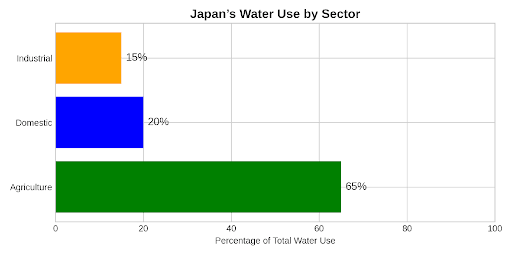
Figure 1. Japan’s Water Use by Sector
Climate and Environmental Pressures
Climate change is intensifying pressure on Japan’s water system. Reduced snow storage, increased evaporation, and more variable rainfall patterns have lowered dam inflows in several regions. Coastal areas, particularly around the Seto Inland Sea, face growing risks of groundwater salinization due to sea-level rise.
Hotter summers increase irrigation demand while accelerating evapotranspiration, reducing overall water-use efficiency, and contributing to yield declines in rice and other crops during recent heatwaves. In addition, water quality is being affected by sediment and nutrient runoff, which poses risks to fisheries and aquaculture.
Urban areas face different challenges. Typhoons and extreme rainfall events can disrupt supply systems and contaminate reservoirs, leading to higher treatment costs and infrastructure damage.
Water Needs and Emerging Pressures
Agriculture continues to require large and stable water supplies, but aging irrigation infrastructure and a shrinking rural workforce make management increasingly difficult. At the same time, domestic users expect reliable access to clean water regardless of seasonal variability.
Population decline has slightly reduced overall municipal water demand, but it has also increased the per-person cost of maintaining infrastructure. Meanwhile, emerging industries such as semiconductor manufacturing in Kyushu are creating new demands for high-purity water, further pressuring the system.
Japan’s Response and Outlook
Because of increased pressures on Japan’s water supply, it promotes integrated water resources management (IWRM) to balance use and conservation, with over 2,700 dams regulating seasonal flows; utilities curbing leaks and metering households; and major cities recycling wastewater for non-potable uses. Farmers increasingly employ precision irrigation and drip systems, while local “smart” water projects explore greywater reuse in small communities. Plans include expanding reservoir capacity, reinforcing levees, improving sediment control, and strengthening early-warning systems. Also, the national “mizu-no-kansha-day” campaigns continue to raise public awareness of conservation.
How Climate Action Affects Water Security
Addressing Japan’s climate commitments directly strengthens national water security. Lower greenhouse gas emissions can help moderate long‑term precipitation volatility. At the same time, adaptation measures, such as expanded storage, wastewater reuse, and ecological conservation, will secure reliable supplies for both farms and families. Ultimately, Japan’s challenge is not absolute scarcity but the management of growing variability in a warming climate. Sustained policy leadership, continued fiscal investment, and active citizen participation will determine whether the country can preserve its long‑standing reputation for safe, dependable water through the next generation.
This Post was submitted by Climate Scorecard Japan Country Manager, Delmaria Richards.
Learn More Resources
- Food and Agriculture Organization. (1997). Aquastat: Japan Country Profile. https://openknowledge.fao.org/server/api/core/bitstreams/379918eb-4ee7-4c23-86ba-7680cdd690a1/content#:~:text=CLIMATE%20AND%20POPULATION-,Geography,776%20m%20above%20sea%20level.
- Organization for Economic Co-operation and Development. (2029, May 11). Innovation, Agricultural Productivity and Sustainability in Japan. https://www.oecd.org/en/publications/innovation-agricultural-productivity-and-sustainability-in-japan_92b8dff7-en/full-report/component-6.html#:~:text=Despite%20small%20shares%20of%20agriculture,e.g.%20residential%20or%20commercial%20uses).
- World Bank Group, 2024. Renewable internal freshwater resources per capita (cubic meters). https://data.worldbank.org/indicator/ER.H2O.INTR.PC
- Japan Commission on Large Dams. (2026). Map of Japanese Dams. https://search.jcold.or.jp/dammap.html