

Fossil fuels continue to account for the majority of Japan’s energy mix.
The landscape of renewable energy in Japan is changing steadily yet unevenly. Solar power is already a key component of Japan’s electrical system, and wind energy is finally gaining traction after years of sluggish development, more than ten years after the Fukushima accident changed the country’s energy strategy. However, fossil fuels continue to account for the majority of Japan’s energy mix despite these developments, highlighting the enormity of the task ahead as Japan strives to achieve its 2050 carbon-neutrality goal.
Japan generated about 97.5 terawatt-hours (TWh) of solar electricity in 2023, supplying roughly 11.3% of national power demand (IEA, 2024). This places Japan among the world’s largest solar producers. Wind energy, by contrast, contributed 10.2 TWh, or just around 1% of total electricity generation. Combined, solar and wind produced approximately 108 TWh, nearly all of which was consumed domestically. Japan does not export renewable electricity because it lacks international grid interconnections that would facilitate export. Unlike Europe’s integrated power network, Japan’s islanded grid means all solar and wind energy is used within its borders.
Solar power has experienced tremendous growth. Japan generated less than 10 TWh of solar energy in 2010. Solar installations increased dramatically following the implementation of substantial feed-in tariffs in 2012, reaching nearly 100 TWh by 2023. Due to regulatory obstacles and a lack of suitable land, wind energy has grown more slowly. However, offshore wind is expected to grow, as Japan’s 2030 energy strategy aims for 36-38% of electricity to come from renewables. New wind projects in Akita, Chiba, and Nagasaki will come online, although solar is expected to remain the largest contributor (METI, 2024).
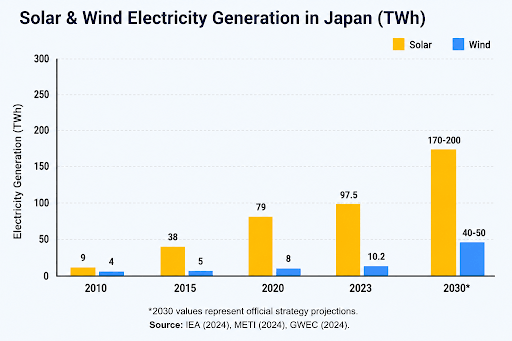 Figure 1. Growth of Solar and Wind Electricity Generation in Japan (2010–2030). Data compiled from the International Energy Agency (IEA) and Japan’s Ministry of Economy, Trade and Industry (METI).
This Post was submitted by Climate Scorecard Japan Country Manager Delmaria Richards.
Core Structural and Policy Barriers
Japan faces several structural and policy barriers, including, but not limited to, geographic location, grid congestion, permitting timelines, and energy costs. Much of Japan is mountainous, leaving limited land available for large solar farms. Another obstacle is grid congestion. Some regions with abundant renewable energy resources, particularly Hokkaido and northern Japan, lack sufficient transmission infrastructure to deliver electricity to major population centers efficiently. Wind power projects also face lengthy environmental review processes and permitting requirements that can delay development for many years. Offshore wind projects encounter additional difficulties, including conflicts with fishing activities, limited port infrastructure, and high construction costs. Experts argue that these barriers can be reduced through grid modernization, expanded battery storage, streamlined permitting, and investment in floating offshore wind, which is well-suited to Japan’s deep coastal waters (IRENA, 2024).
In Japan, power generation is the primary application of solar and wind energy. While utility-scale solar farms directly supply electricity to regional grids, solar panels are frequently put on the rooftops of homes, businesses, factories, and schools. The main purpose of wind energy is to power residential and commercial districts. Green hydrogen production, electric vehicle charging, and industrial decarbonization are expected to be supported by renewable electricity.
Despite the rapid expansion of solar energy, fossil fuels continue to generate approximately two-thirds of Japan’s electricity, with coal and liquefied natural gas (LNG) being the primary sources (IEA, 2024). Roughly 25% of total generation comes from renewable sources, such as solar, wind, hydro, geothermal, and biomass. Even as offshore wind is expected to grow significantly and solar power has become a major component of the energy system, Japan needs to continue expanding renewable energy to reduce its reliance on imported fossil fuels and meet its climate goals.
Japan’s renewable energy story reflects significant progress alongside ongoing structural challenges. Solar energy has successfully emerged as a mainstream domestic electricity source, and offshore wind development is finally gaining critical traction. However, for the country to truly revolutionize its power sector, it must aggressively dismantle infrastructure, regulatory, and geographic barriers. Overcoming these bottlenecks is no longer just an environmental ideal but an absolute necessity if Japan is to successfully eliminate its reliance on imported fossil fuels and cross the finish line on its 2050 carbon-neutrality goal. If successful, renewable energy will secure a cleaner, resilient, and fully independent energy future for the island nation.
References
- International Energy Agency (IEA). 2024. Where does Japan get its electricity? https://www.iea.org/countries/japan/electricity
- Institute for Sustainable Energy Policies. (2024). 2023 Share of Electricity from Renewable Energy Resources in Japan [Preliminary Report] https://www.isep.or.jp/en/1529/
- Ministry of Economy, Trade and Industry (METI). 2024. Strategic Energy Plan. https://www.enecho.meti.go.jp/en/category/others/basic_plan/
- Ministry of Economy, Trade and Industry (METI). 2024. Japan’s Strategy to Expand Renewable Energy Contributes to the World’s Efforts toward Tripling Renewable Energy. https://www.enecho.meti.go.jp/en/category/special/article/detail_198.html
- International Renewable Energy Agency (IRENA). 2024. FLOATING OFFSHORE
WIND OUTLOOK. https://www.irena.org/-/media/Files/IRENA/Agency/Publication/2024/Jul/IRENA_G7_Floating_offshore_wind_outlook_2024.pdf