

Based on current trends, total emissions will continue to decline modestly, but not at the pace required to meet mid- and long-term goals.
As of now, there are no officially published final figures for Spain’s total greenhouse-gas emissions in 2025 from the national statistical agency (INE) or the National Inventory — the most recent complete validated annual data are for 2024. The INE reports that Spain’s economy emitted 280 million tonnes of greenhouse gases in 2024 (in CO₂-equivalent) — a very slight decrease of 0.2 % from 2023.
For 2025, preliminary quarterly data show that, in the first quarter alone, Spain emitted about 74.1 million tonnes of GHGs — roughly a 2.2% decline compared with the same quarter in the previous year. The long-term trend for Spain’s emissions (excluding land use & forestry) is about 38–39% below 2005 levels by 2023.
The estimate for 2026:
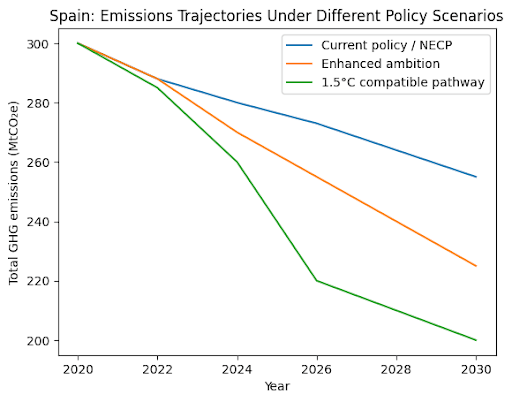
Based on current trends, total emissions will continue to decline modestly, but not at the pace required to meet mid- and long-term goals. A realistic estimate for Spain by the end of 2026 is roughly 1–3% lower than 2024 levels, i.e., around 272–275 MtCO₂e in total. This forecast assumes continued renewable deployment, energy efficiency gains, and electrification momentum, but slower drops in difficult sectors like transport and agriculture.
Sector-by-Sector Estimates
- Energy & Electricity Generation
- Electric sector emissions fell 16.8% in 2024 alone amid a 3.5% GDP growth.
- Spain is rapidly expanding solar and wind power, with renewables accounting for 26% of energy use in 2024.
Significant reduction relative to 2024, potentially 5% to –10%. Renewables, already reducing reliance on coal and gas in electricity, explain much of the historical decline, making them the major contributor to the overall emissions decline.
- Transportation
- Transport is the largest source, ~32.5% of total GHG emissions.
- Emissions have decreased since their peak, but not by enough.
Small reduction (–1% to –3%), driven by rapid EV adoption and charging infrastructure build-out. But fossil fuels still dominate road transport, and aviation/maritime are hard to decarbonize. This sector will remain stubbornly high relative to others unless electrification accelerates.
- Agriculture & Land Use
- Agriculture 12.2% of emissions in 2023.
- Agriculture saw a modest 2.1% reduction vs. 2022.
Modest decline (–1% to –2%), unless stronger methane and fertilizer measures are adopted. There’s also potential for carbon removal via land-use practices, but this is not yet scaling fast.
- Industry & Other Sectors
Industry cuts continue as electricity and efficiency improve.
Moderate reduction (–2% to –5%). Industry is electrifying and using cleaner fuels, but heavy industrial processes still emit.
Spain’s formal targets for the 2030 Climate Goals
Spain’s updated National Integrated Energy and Climate Plan (NIECP) sets a 32% reduction vs 1990 by 2030.
- If Spain is around –38% below 2005 by 2023/24, this roughly aligns with a 30% cut vs 1990.
- However, the pace is slowing — 2024 showed only a slight drop — and transport/agriculture cuts are limited.
Therefore, Spain is on track to meet the formal EU-aligned 2030 target (32% reduction) but unlikely to exceed it significantly without stronger measures.
Paris Agreement Goals align with limiting warming to 1.5–2°C, which is often interpreted as:
- 50% GHG reduction by 2030
- Net zero (carbon neutral) by 2050
Current Spanish climate policies are insufficient to achieve a 50% reduction by 2030. The NIECP target (32%) is well below 50%. Paris-aligned independent pathways suggest transport must cut emissions by 79% relative to 1990 by 2040 and reach near-zero by 2050–2053. Spain will not meet Paris Agreement Goals (50% by 2030) under current policy without further acceleration in clean mobility, industrial decarbonization, biofuels/e-fuels, and agriculture emissions cuts. The current 2050 carbon-neutrality goal is aligned with Paris in intent, but requires much stronger action.
Estimated Change by 2026
| Sector | Estimated Change
by End of 2026 |
Key Drivers |
|---|---|---|
| Total GHG emissions | –1% to –3% | Slowly declining overall |
| Energy/Electricity | –5% to –10% | Renewables, coal phase-out |
| Transport | –1% to –3% | EVs, efficiency, but fossil persistence |
| Agriculture | –1% to –2% | Modest improvements |
| Industry | –2% to –5% | Electrification, cleaner fuels |
In summary, emissions in Spain will likely be lower in 2026 than in 2024, but only modestly. Spain will likely meet its current 2030 NECP objective (32% cut vs 1990) but not the stronger 50% target needed for robust Paris alignment. Carbon neutrality by 2050 remains a goal, but it needs significant acceleration across all sectors.
This Post was submitted by Climate Scorecard Spain Country Manager, Juanjo Santos