

Earlier 2026 projections to reduce emissions by 20% below the 2005 level are now expected to reach 16%, continuing 2023 trends unless major policy changes occur.
Canada issued its second Progress Report on Canada’s 2030 Emissions Reduction Plan under the Canadian Carbon Neutrality Accountability Act in December 2025.
Federal government data is always reported two years after the fact, given the time to collect it, so only 2023 federal data is available to project a 2026 scenario.
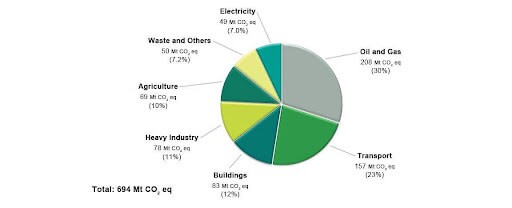
In 2023, emissions excluding Land Use, Land-Change and Forestry (LULUCF), were 694 Mt CO2 eq, a decrease of 65 Mt (-8.5%) from 2005, against a backdrop of significant population growth, 32 million in 2005 to over 40 million in 2023.
Since 2005, emissions have increased in the Oil and Gas sector (13 Mt or 6.9%) and Agriculture sector (3.7 Mt or 5.6%), offset by decreases in other sectors, including Electricity (-67 Mt or -58%), Heavy Industry (-9.5 Mt or -11%), and Waste (-3.9 Mt or -7.2%). Transport emissions have increased gradually, except during the early COVID-19 period, with 2023 data slightly above 2005 levels (0.37 Mt, or 0.2%).
Figure 2-1. Breakdown of Canada’s GHG emissions by economic sector (2023)
Between 2005 and 2023, emissions decreased in most provinces and territories, except for Alberta (13 Mt or 5.1%), Manitoba (0.59 Mt or 2.8%), Nunavut (0.13 Mt or 22%), and Yukon (0.11 Mt or 19%).
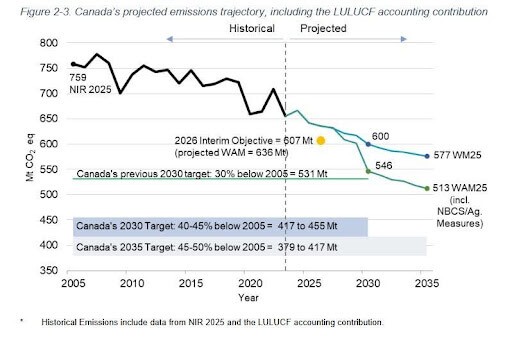
Projected data above includes Nature Based Climate Solutions and LULUCF reports ‘with (existing) measures’ (WM) or ‘with additional measures’ (WAM).
New projections released by Environment and Climate Change Canada in late December 2025 show Canada will fall short of its 2030 climate goals—but is on track to meet halfway (21%) of its targets of 40% (2030) and 45% (2035) reductions below 2005 levels. Additional climate policies could see a 28% reduction by 2030.
Prime Minister Carney has already stated that Canada will not meet its 2030 or 2035 emissions targets under the existing plan. Canada’s commitment to net-zero by 2050 is codified in law through the Canadian Net-Zero Emissions Accountability Act.
Earlier 2026 projections to reduce emissions by 20% below the 2005 level are now expected to reach 16%, continuing 2023 trends, unless major policy changes occur. Continued increase in oil and gas production, but with methane regulations, industrial carbon prices, clean fuel requirements, and increased deployment of carbon capture technologies to reduce emissions impact. Transportation emissions are expected to decrease as zero-emission vehicles become more prevalent, supported by EV Availability Standards. Electricity decarbonizing with clean electricity regulations and increased adoption of renewable generation and storage technologies. Heavy Industry emissions are expected to decline through fuel switching, electrification, efficiency improvements, carbon capture/storage, and facility modernization. Building emissions are expected to fall due to electrification, heat pump adoption, and more stringent building codes, as well as efficiency gains. Agricultural emissions are expected to remain stable or decline slightly under WAM scenarios, given improved land-use practices and nitrogen management. Lastly, Waste diversion programs will keep emissions stable, or in the WAM scenario, implementation of federal landfill gas regulations will reduce emissions.
Climate Action Tracker sees Canada remaining far from 1.5°C compatibility on a global least cost basis. Carney’s platform outlined commitments to finalize clean technology investment tax credits, investing in energy retrofits and EV infrastructure, and strengthening industrial carbon pricing. He has already dropped key planks from Canada’s climate plan by removing consumer carbon pricing, signaling support for new fossil fuel infrastructure, which contradicts phasing out fossil fuels— pausing the electric vehicle mandate, backing additional LNG exports, weakening industrial carbon pricing, and potentially supporting construction of another bitumen pipeline to the Pacific coast.
The Canadian Climate Institute (CCI), Canada’s leading climate think-tank, points out, given the recent 2026 Progress Report, the need for quick action on industrial carbon pricing, clean electricity, and a longer-term policy reboot beyond. Current policies aren’t delivering 2030 or 2035 targets at a time when Canada faces compounding pressures: devastating wildfires, economic slowdowns tied to U.S. tariffs, intensified competitiveness risks for industry, and affordability impacts on households. These pressures threaten fragile progress on the emissions front, while record oil sands production and new LNG facilities push national emissions upward.
CCI states that recognizing that 2030 targets are out of reach is not a reason to give up; it’s a sign that it’s time to restore momentum. In an era of global uncertainty, shifting trade relationships, and an accelerating energy transition, there are proven tools, including strengthened methane regulations, modernized industrial carbon pricing, and cleaner vehicles and fuels. Canada needs an updated, evidence-based climate plan that both aligns with Canada’s legislated net-zero commitments and contributes to a more secure and affordable future.
Submitted by Climate Scorecard Canada Country Manager, Diane Szoller.