

Energy-poor / low-income households living in energy-inefficient homes and Rural residents who are highly car-dependent (often older populations).
The two hardest-to-reach population groups in Spain for meeting the NDC (2030) are:
a)Energy-poor / low-income households living in energy-inefficient homes (concentrated in Extremadura, Castilla-La Mancha, Castilla y León, Andalusia). These households struggle to heat/cool homes, have limited purchasing power and low participation in renovation/subsidy schemes.
What characterizes them is they all live in a household income low or at-risk-of-poverty; often single-parent, single elderly or very small households; low education levels more common. They live in old, poorly insulated dwellings (higher heat loss), sometimes off-grid heating (wood, oil, inefficient gas), limited ability to invest in retrofits or modern heating (heat pumps). Many do not receive existing social support (large “hidden” coverage gap for the bono social electrical/thermal).
Eurostat reported that 20.8% of Spain’s population were unable to keep their home adequately warm in 2023 — that corresponds to roughly 10.1 million people (using Spain population 48.6 million, INE 2024). That implies in the order of 4.0 million households (average household ≈2.5 persons). Severe energy-poverty hotspots are located in: Extremadura (26.5% severe), Castilla-La Mancha (18%), Castilla y León (16%) per recent Spanish studies/analyses. Large urban pockets also exist, but inland/southern regions show higher incidence.
b)Rural, car-dependent residents
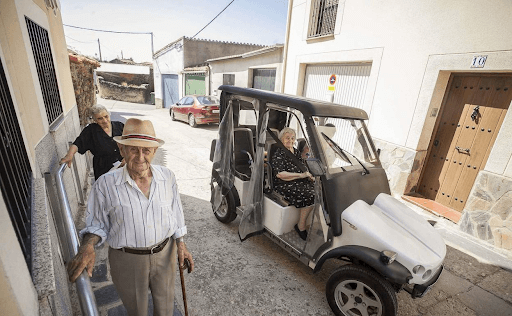
Rural residents who are highly car-dependent (often older populations) living in low-density municipalities (many in Aragón, Castilla-La Mancha, Castilla y León, parts of Galicia and Extremadura). They lack public transport and long travel distances make transport decarbonization difficult.
These are residents of small municipalities (many with <5,000 inhabitants), where public transport is sparse or absent. High dependence on private cars for work, shopping, health access. A higher share of older adults lives in very small municipalities.
Roughly 18% of Spain’s population lives in rural areas (8.9 million people, latest year estimates). Rural population is especially concentrated (by share) in Aragón, Castilla-La Mancha, Castilla y León, Extremadura and some inland provinces. A substantial fraction of rural residents are older (higher than urban averages).
Many energy-poor households live in rural/low-density areas and older housing stocks, so targeting one program can help both groups because both groups overlap in many places (energy-poor people living in rural, older housing stock). Transport and residential energy are among Spain’s largest emission sources, so these groups are critical to reach NDCs.
These groups are hard to bring into NDC progress due to following barriers:
- Insufficient purchasing power / investment capacity. The capital cost of deep energy retrofits (insulation, double glazing, heat pumps) and of EVs is prohibitive for low-income households. Existing social measures (“bono social”, grants) do not reach all eligible households.
- Limited access to suitable alternatives.
- Rural areas: weak or non-existent public transport networks and charging infrastructure; distances make switch to low-emission options harder.
- Housing stock: many rural/older homes cannot be made efficient quickly without skilled local contractors and coordination. Nowadays there is a lack of both.
- Information, administrative and procedural barriers. Complex application processes, lack of one-stop advice, low digital access or digital skills (especially among older residents) reduce take-up of subsidies. Studies show many potential beneficiaries of social electricity bonuses are not receiving them because of procedure/coverage issues.
- Behavioral / socio-demographic factors. Older adults may be less likely to adopt new technologies, less comfortable with online processes, and more attached to existing heating/transport choices. Rural social norms and necessities (no alternatives) reinforce car use.
- Structural/territorial constraints. High per-capita cost to deliver public transport or distributed renewables in low-density areas; policy instruments are often designed at national level and not tailored to rural realities.
Because of these constraints, these groups are not currently contributing their potential share of emissions reductions — even though technical solutions exist.
Proposal 1 — “Fast Retrofits + One-Stop Social Renovation” (target: energy-poor households)
Create a national accelerated program that combines (A) quick, low-cost energy efficiency measures (draught-proofing, loft/cavity insulation, LED lighting, thermostatic controls, efficient electric heaters/heat-pump minisplits where feasible), (B) targeted replacement of highly inefficient boilers with efficient electric heat pumps for eligible households, and (C) a “one-stop” local assistance team (technical + administrative) that helps households apply, get grants, and complete works. It will make a difference due to low/medium-cost measures delivering fast energy savings and comfort with short payback and immediate fuel-bill relief — cutting household emissions and political resistance to deeper reforms.
Besides, one-stop local support overcomes administrative and information barriers that currently block uptake of assistance. In fact, many eligible households do not receive bono social or renovation grants because procedures are complex.
Target the 4 million households estimated to be energy-vulnerable (priority first wave: the 1–1.5 million most severe cases based on income, disability/elderly, and winter thermal vulnerability); prioritize Extremadura, Castilla-La Mancha, Castilla y León, Andalusia. (Exact targets refined from national household registries and social services.)
Prioritize low-cost measures (€1,000–€4,000 per household) that typically pay back quickly via energy bill savings. For highest-need households, combine with deeper measures using co-funding (EU/PRTR + national + regional). Existing IDAE programs and PRTR funds can supply initial capital (and contracting capacity).
Implementation steps (1–3 years)
- Month 0–3: National decision & budget allocation (MITECO + IDAE). Publish a fast-track call for proposals to Autonomous Communities (ACs) and municipalities to set up local “one-stop” teams. Use existing PRTR/PNIEC/IDAE channels to source funding.
- Month 3–9: ACs nominate municipal/local partners (social services, energy agencies, NGOs) to staff one-stop teams; teams run outreach lists using social benefits registries to identify eligible households (targeted outreach reduces leakage).
- Month 6–24: Rolling implementation of retrofit packages (local contractors trained through voucher schemes; priority retrofits executed first). Heat pump replacements reserved for households where electrification is cheapest and most impactful.
- Month 12–36: Monitoring, second wave expansion; integrate with PV + community energy options where feasible.
It would be doable in 1–3 years because it uses available instruments (IDAE, PRTR funds); focuses on shallow retrofits first (fast procurement) and establishes local teams to eliminate administrative delays. Many EU member states ran similar rapid programmes after the energy-price spikes — Spain already has relevant institutional building blocks.
There must be involved the “Ministerio para la Transición Ecológica y el Reto Demográfico” (MITECO) + IDAE (executive delivery + technical guidance) and partner Autonomous Communities (deliver local deployment), municipalities, social services (identify households), regional energy agencies, NGOs (community outreach), accredited contractor networks, European PRTR/Recovery funds administrators.
How to measure outcomes (KPIs)
- Outputs: # households served; % of targeted households covered; average € per household invested.
- Energy & emissions: measured pre/post household energy consumption (metered or survey), estimated kWh saved per household and converted to tCO₂e avoided using standard Spanish electricity/heat emission factors.
- Social metrics: % of beneficiaries previously not receiving bono social; number of households reporting ability to keep home adequately warm (survey).
- Cost metrics: € per tCO₂ avoided (initial estimate, updated with monitoring).
Proposal 2 — “Rural Low-Emission Mobility Accelerator” (target: rural car-dependent residents)
Create a package of measures for low-density municipalities combining (A) on-demand electric shared mobility (municipal EV fleets + ride-pooling apps with social fares), (B) targeted micro-bus / demand-responsive bus services to connect to regional hubs, and (C) an EV charging fast-rollout (priority chargers in towns + smart, municipally-managed charging with simplified permitting).
Rural car dependency is a major contributor to transport emissions; providing practical, affordable alternatives removes the “no alternative” barrier and replaces many solo ICE trips. Demand-responsive transport has proven to reduce private car-km in rural EU pilots.
Pilot 100–300 municipalities in high-need provinces (e.g., provinces in Aragón, Castilla-La Mancha, Castilla y León, Extremadura). Each pilot: 1–2 shared EVs, 1 demand-responsive minibuses, 1–2 public chargers. Shared EV fleets (municipal or cooperative ownership) lower per-user capex; demand-responsive services are cheaper than fixed sparse bus lines. Funding mix: national mobility decarbonisation funds, MITMA transport budgets, EU cohesion funds + local municipal co-funding.
Implementation steps (1–3 years)
- Month 0–3: National ministerial remit: MITECO (policy & funding), MITMA (mobility operations), and regional governments issue a joint call for municipal pilots.
- Month 3–9: Select municipalities, set up public-private partnerships (PPP) or municipal cooperatives; procure EVs and minibuses; local NGOs/associations take role in outreach and user registration.
- Month 6–24: Deploy shared EVs + on-demand service (app and phone booking for low-digital users). Install chargers using standardized fast-permit process (national guidance to speed up permitting).
- Month 12–36: Evaluate, refine tariffs/subsidies for low-income riders, scale to next tranche.
Several EU rural mobility pilots have shown that rapid roll-out is feasible within months. Demand-responsive tech (apps/dispatch) and small EV fleets can be procured rapidly. For this to happen there must be involved both MITECO and Ministerio de Transportes, Movilidad y Agenda Urbana (MITMA). MITECO for funds and climate policy; MITMA due to its operational expertise. They should partner with Autonomous Communities, provincial councils, municipalities, mobility operators, local cooperatives, EU regional funds managers.
How to measure outcomes (KPIs)
- Mobility outputs: # EVs deployed in pilots; # rides per month; % reduction in private ICE vehicle-km in pilot area.
- Emissions: estimated reduction in tCO₂e per year from measured modal shift (vehicle-km reductions × emission factors).
- Social metrics: user satisfaction; % of elderly / low-income users served; average cost per ride.
- Economic metric: public € per tCO₂ avoided and cost per passenger-km compared to small fixed bus lines.
Complementary actions:
- Simplify access to existing aids: automatic identification of eligible households (link social security / IMV registries to bono social and renovation schemes so eligible people are auto notified). This reduces leakage and can be implemented via administrative coordination within 6 months.
- Local training & micro-contractor certification: quick training programs in rural areas to ensure local labour can perform retrofits and install chargers — creates local jobs and reduces logistical premium for rural works.
Expected impact:
- If the retrofit program reaches 1 million of the worst energy-vulnerable households with a modest package that saves 2,000 kWh/year/household on average, that is 2 TWh/year saved — roughly 0.5 MtCO₂e/year avoided (order-of-magnitude; depends on emission factors).
- Rural mobility pilots replacing 10% of single-occupant ICE car-trips in pilot municipalities could cut local transport emissions significantly and demonstrate scalable models for national roll-out.
Person who can decide to put into place these proposals.
Name: Sara Aagesen Muñoz
Title: Vicepresidenta tercera del Gobierno y Ministra para la Transición Ecológica y el Reto Demográfico (Minister, MITECO).
Contact e-mail (official public contact boxes): informacionma@miteco.es (general citizen information mailbox) — for press/communications: bzn-prensa@miteco.es.
This Post was submitted by Climate Scorecard Spain Country Manager, Juanjo Santos.