

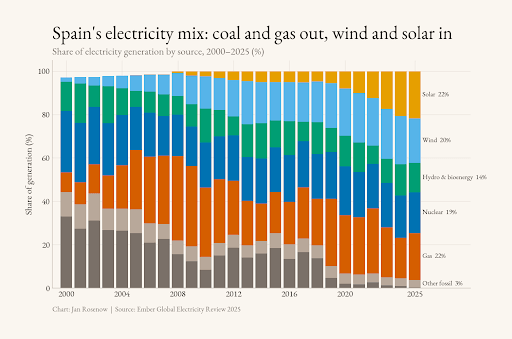
Spain has emerged as a global clean energy superpower, shattering its own historical records by generating over 56.8% of its national electricity from renewable sources. Coal has been effectively eliminated, plummeting to less than 3% of the annual electricity mix.
Across the sun-scorched plains of Extremadura and the windswept hills of Galicia, a quiet environmental revolution has matured into a roaring macroeconomic success. Driven by an aggressive expansion of solar and wind power, the Iberian nation has fundamentally restructured its national grid. It has drastically reduced its reliance on fossil fuels and positioned itself as a critical exporter of green electricity to continental Europe. [
Current Production and Consumption Volumes
The backbone of Spain’s contemporary power sector relies on the complementarity of its two primary infinite resources: wind and solar. According to updated figures from the national grid operator, Red Eléctrica de España (REE), wind power remains the single largest domestic source of electricity. It accounts for roughly 25% of the total generation mix. Solar photovoltaic (PV) systems follow tightly behind, contributing an impressive 19% to the grid.
When combined with stable hydroelectric backups and biomass, Spain’s clean energy fleet routinely satisfies more than half of the nation’s total power consumption. This structural dominance was put on display during an extraordinary operational milestone. For nine consecutive hours on a standard, high-demand weekday, Spain’s entire peninsular electricity demand was met 100% by renewable generation alone. This operational feat proved that a large, industrialized European economy can successfully sustain its grid without relying on active fossil fuel or nuclear baseloads.
The Clean Energy Trajectory: Past, Present, and Future
This current paradigm represents a radical shift from the prior decade. In the early 2010s, regulatory instability and the infamous “sun tax” severely stalled domestic deployment. However, the full repeal of restrictive policies in 2018 triggered a massive wave of private capital. Solar capacity subsequently exploded from a negligible 3% share to its current near-fifth of total national output.
Looking ahead, Spain’s strategic ambitions are codified within its updated National Integrated Energy and Climate Plan (PNIEC). The government has committed to producing 81% of its electricity from renewable sources by 2030. To achieve this, utility-scale solar installations are projected to reach 76 gigawatts (GW)—up from approximately 29.5 GW—and be complemented by a targeted expansion of the wind fleet to over 50 GW.
Grid Barriers and Technical Solutions
Spain’s rapid transition has outpaced its underlying infrastructure, creating a structural issue known as the “green energy paradox”. On exceptionally clear and windy days, solar and wind installations generate vast surpluses of electricity. This drives wholesale market prices down to zero, causing an economic issue called price cannibalization. Because the physical grid lacks the transmission capacity to absorb these sudden localized surges, grid operators are frequently forced to order clean energy plants to shut down. This deliberate wasting of free electricity is technically termed curtailment.
Resolving this operational bottleneck requires significant upgrades to the national energy architecture:
- Utility-Scale Storage: Deploying massive grid-connected battery arrays and pumped-storage hydropower systems to absorb excess afternoon solar generation for release during evening demand peaks.
- Industrial Electrification: Incentivizing heavy manufacturing, commercial transport, and domestic heating systems to switch directly to electricity, thereby expanding the base consumer pool.
- The Green Hydrogen Economy: Utilizing unabsorbed, zero-cost solar electricity to power industrial electrolyzers, converting water into green hydrogen for chemical manufacturing and heavy transport.
The Renewable Curtailment vs. Thermal Activation Paradox
This situation exposes a striking structural irony within modern energy grids: the paradox of green curtailment versus fossil-fuel dependency. When wind and solar power generation surges during peak weather hours, the grid often lacks the battery infrastructure or transmission capacity to absorb the excess electricity, forcing operators to intentionally shut down clean power plants—a process known as curtailment. Yet, as the blackout incident demonstrates, the moment weather conditions abruptly shift or consumption patterns spike, the system becomes highly vulnerable to severe voltage fluctuations.
Because renewable sources cannot be dialed up on demand without massive storage systems, the grid operator is forced to rapidly return to carbon-heavy gas-fired thermal plants to provide the necessary “baseload” stability. Consequently, the grid ends up discarding free, zero-emission green energy during times of abundance, only to burn expensive, polluting fossil fuels moments later to prevent a total blackout.
The small vs the large energy consumer pricing Paradox
The cost of the major blackout in Spain is being paid by the small consumer through their electricity bill, according to the proposal by the National Markets and Antitrust Commission (CNMC). The direct impact of restoring the supply and system adjustment services following the April 28th incident exceeded 42 million euros (and up to 800 million euros in indirect losses and impacts on the system). This amount is charged to users as ‘system adjustment services’ on their bills.
Large energy consumers (such as steel mills, cement plants, or chemical industries) are financially compensated through an official mechanism managed by Red Eléctrica de España (REE) called the Active Demand Response Service (SRAD). These industries do not shut down for free; they participate in competitive auctions organized by the Government and REE. The money they will receive is determined during these biddings. The economic volume is very high because it is key to preventing blackouts. The budget allocated to cover these compensations for industries amounts to 434 million euros. This money is funded directly through the regulated tolls and charges that all consumers pay on their electricity bills.
On the other hand, the main party responsible for the “Spanish big blackout” was Red Eléctrica de España (REE). The final report issued by the Government determined a calculation error by the system operator, which failed to activate enough thermal (gas) power plants to control the voltage and did not adequately anticipate the drastic fluctuation in demand. Private generation companies also received part of the blame for failing to respond in time to stabilize the grid, and big industries were not called on to switch off in time.
Cross-Border Energy Export Markets
Historically isolated from the broader European grid as an “energy island,” Spain has successfully leveraged its geographic surplus to become a major net exporter of electricity. The primary beneficiary of this clean energy surplus is neighboring Portugal, which shares the integrated Iberian Market (MIBEL). [
Furthermore, despite complex mountainous terrain, Spain has expanded its high-voltage interconnections across the Pyrenees into France. This allows cheap Spanish solar energy to displace more expensive gas-fired generation in Central Europe during peak daylight hours. Minor subsea interconnectors also channel power southward to Morocco, stabilizing North African grid infrastructure during strategic operational windows.
Primary Socio-Economic Uses of Clean Energy
The massive volume of electricity harvested from Spain’s wind turbines and solar fields is directed into three primary economic pillars:
- Industrial and Residential Supply: Powering domestic homes and major industrial manufacturing zones, which benefits local businesses via lower utility bills.
- The Automotive Transition: Feeding the nation’s expanding electric vehicle (EV) charging infrastructure and supporting massive new domestic battery manufacturing plants.
- Decentralized Self-Consumption: Rapidly expanding rooftop solar arrays on residential homes and commercial warehouses, insulated from international geopolitical fossil fuel shocks.
The Balance of Power: Renewables vs. Fossil Fuels
The structural retreat of fossil fuels within the Spanish economy is an ongoing reality. Coal has been effectively eliminated, plummeting to less than 3% of the annual electricity mix. High-efficiency, combined-cycle natural gas plants still account for roughly 20% of generation, but their operational role has fundamentally changed. Rather than acting as a primary power source, gas facilities now serve as a flexible backup system, firing up only when weather conditions cause renewable output to drop. With more than half of the nation’s grid supplied by green energy and an additional 21% by zero-emission nuclear plants, Spain’s total carbon-free electricity generation is a commanding 77%.
This Post was submitted by Spain Country Manager, Juanjo Santos.
Learn More Resources
- Red Eléctrica de España (REE) – Official System Reports
- International Energy Agency (IEA) – Spain Energy Profile
- Ember Climate – Spain National Energy Insights
- CaixaBank Research – The Spanish Green Energy Advantage