

Water security now sits at the centre of both the climate and development agenda, shaping public health, food production, energy generation, and urban livelihoods.
South Africa’s water crisis is not primarily a drought problem. It is a structural one.
The country receives roughly 500 mm of rainfall per year, well below the global average of 860 mm, distributed unevenly across provinces and seasons. Rising demand, aging infrastructure, polluted rivers, and little remaining capacity to develop new surface water sources have converged into a slow-moving emergency.
Water security now sits at the centre of both the climate and development agenda, shaping public health, food production, energy generation, and urban livelihoods. The question is no longer whether South Africa is water-stressed. It is whether the country can manage that scarcity faster and more equitably than it has so far.
Thirty Years of Change: Access Gained, Reliability Lost
Since 1994, South Africa has extended formal water access to millions of people. Household access to municipal water rose from 78.4%, around 9.2 million households, in 2004 to 80.4%, or roughly 15.2 million households, by 2023. That represents genuine progress in service delivery.
The problem is that, on paper, access has not consistently meant water at the tap. In many municipalities, residents face interruptions, burst pipes, and unsafe water supplies even where infrastructure nominally exists. Recent Stats SA survey data show regression after years of incremental gains, suggesting the system is degrading faster than it is being maintained.
Who Needs the Water
Agriculture is the heaviest consumer. Irrigation underpins fruit, wine, sugar, vegetable, and grain production, and in drier regions, it is often what keeps farming viable at all. Shortfalls affect food security, rural employment, and export earnings simultaneously.
Domestic demand is rising too. Population growth across Gauteng, the Western Cape, KwaZulu-Natal, and the Eastern Cape has strained systems designed for smaller communities. In informal settlements, where residents need safe water reliably, many municipalities lack the technical capacity and finances to deliver it consistently.
Where the Water Comes From
South Africa primarily draws on surface water from dams and rivers, supplemented by groundwater, inter-basin transfers, wastewater reuse, and limited coastal desalination. Most viable surface water has already been developed. The Lesotho Highlands Water Project, which channels mountain water into the Vaal system, supplies Gauteng but also illustrates how dependent major urban regions have become on water moved over long distances. Groundwater and treated wastewater reuse will need to take on a larger share as climate variability tightens conventional supply.
What Is Squeezing the System
South Africa’s water supply is being squeezed from several directions at once, and the pressures are compounding rather than occurring in isolation.
Table 1: Key pressures on South Africa’s water supply and their primary impacts
| Pressure on supply | Main impact |
|---|---|
| Drought and heat | Lower dam levels, higher evaporation, reduced crop yields |
| Urban growth | Greater demand on municipal systems already under strain |
| Leaking infrastructure | Treated water lost before it reaches homes or farms |
| Pollution | Higher treatment costs and a smaller pool of usable supply |
| Invasive alien plants | Reduced river runoff and stressed catchments across key watersheds |
Infrastructure loss is the most quantifiable of these. The Department of Water and Sanitation’s 2023 No Drop assessment found that national non-revenue water rose from 37% in 2014 to 47% in 2023. Nearly half of all treated water is now lost before it reaches a paying customer, through leaks, faulty meters, illegal connections, and weak billing. This drains municipal budgets and leaves less available for the repairs that would stop the losses.
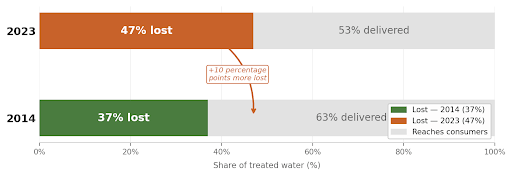
Figure 1: Non-revenue water as a share of treated water, South Africa, 2014 vs 2023. The coloured segment shows water lost to leaks, illegal connections, and billing failures; the grey segment shows water that reaches consumers. Source: Department of Water and Sanitation, No Drop Report 2023.
Climate change intensifies all of these pressures. Higher temperatures increase evaporation from dams, soils, and crops. Rainfall is growing less predictable. Cape Town’s near-collapse during the 2015 to 2018 drought showed how quickly a major city can approach zero. The 2022 floods in KwaZulu-Natal showed the opposite risk: too much water, too fast, destroying infrastructure and contaminating supply for months.
What Is Being Done
The National Water Resource Strategy III sets out the right priorities: reduce losses, expand reuse, develop groundwater, protect catchments, and strengthen regulation. Implementation is the harder part. Fixing leaks, upgrading treatment works, improving billing, and enforcing pollution rules all require sustained funding and capable local institutions. Many municipalities lack both.
There are promising signals. The Water Research Commission funds applied research on loss reduction and irrigation efficiency. Some municipalities have cut leakage through pressure management. WWF South Africa’s water stewardship programs support catchment restoration. These efforts are real, but they need to scale considerably faster.
Climate Action and the Way Forward
Water policy and climate policy have the same agenda. South Africa cannot adapt to a hotter, more volatile climate without reliable water systems, and it cannot secure water without cutting waste, protecting ecosystems, and building infrastructure designed for conditions that no longer resemble the past.
The priorities are clear: repair pipe networks, expand safe wastewater reuse, support water-efficient irrigation, restore degraded catchments, clear invasive alien plants, and invest in early-warning systems for drought and flood. Reliable electricity matters too. Water treatment and pumping are energy-intensive, and although South Africa’s grid is significantly more stable than in recent years, it remains vulnerable to disruption.
Any single dam, policy, or technology will not secure South Africa’s water future. It will depend on managing every source more carefully and reducing every preventable loss. In a country that receives barely half the world’s average rainfall, conservation is not a secondary concern but the foundation on which any serious climate resilience strategy must be built.
This Post was submitted by Climate Scorecard South Africa Country Manager, Jonè Carter.
Learn More Resources
- Statistics South Africa. General Household Survey 2023. Pretoria: Stats SA, 2024.
- Department of Water and Sanitation. National Water Resource Strategy III (NWRS-3). Pretoria: DWS, 2023.
- Department of Water and Sanitation. No Drop Report 2023. Pretoria: DWS, 2023.
- Water Research Commission. Research on water loss, water use efficiency, and non-revenue water in South African municipalities. Pretoria: WRC.
- WWF South Africa. Water Stewardship Programme — catchment restoration and water risk in South Africa.