

Japan’s Emissions Decline Accelerates, but Experts Warn 2026 Will Be a Critical Turning Point for Paris Alignment
For the first time in more than three decades, Japan’s greenhouse gas emissions have fallen below their lowest level in more than three decades, marking a significant milestone in the country’s climate transition. Yet analysts caution that the pace of reductions through 2026 will determine whether Japan can realistically stay on track for its Paris Agreement commitments and its long-term goal of net-zero emissions by 2050.
New figures released by Japan’s Ministry of the Environment show that it emitted 1.017 billion tons of CO₂ equivalent in FY2023, a 4.2% decrease from the previous year and a 27.1% reduction compared to FY2013, considering the exclusion of sinks, the baseline year for Japan’s climate targets (Ministry of the Environment, 2025). The decline reflects lower fossil fuel consumption, expanded renewable energy deployment, and reduced industrial energy demand.
While the downward trend is encouraging, the next three years will be decisive. Japan must accelerate emissions cuts to meet its 46% reduction target by 2030 and its newly announced 60% reduction goal by 2035, as set out in its Nationally Determined Contributions (NDCs). Current progress, though meaningful, remains insufficient to meet these milestones without a rapid scale-up of clean energy and industrial decarbonization.
Projected Emissions Trajectory Through 2026
If current trends continue, including increased renewable generation, gradual nuclear restarts, and improved energy efficiency, it is correct to estimate Japan could reduce emissions by an additional 5-7% by FY2026, bringing total emissions to roughly 0.95-0.97 billion tons CO₂e. This projection assumes steady progress in the energy, industry, and transport sectors (Figure 1).
Figure 1. Japan’s Emissions Trend and 2026 Projection (MtCO₂e)
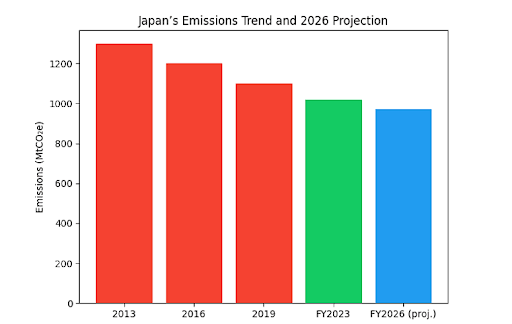
Source: Ministry of the Environment (2025), author projection.
Sector-by-Sector Breakdown
Energy Sector
The energy sector remains Japan’s largest source of emissions, but it is also the fastest-changing. Renewables accounted for 22.9% of electricity generation in FY2023, while nuclear power contributed 8.5%, both of which increased from the previous year (Ministry of the Environment, 2025). As utilities retire aging coal and gas plants while expanding solar and wind capacity, energy-sector emissions could fall an additional 6-8% by 2026.
Industry
Industrial emissions fell by roughly 4% in FY2023, driven by efficiency improvements, electrification, and shifts in production patterns. Continued reductions are likely, given uncertainty about hydrogen supply and the development and deployment of carbon capture, which could slow progress.
Transportation
Transport emissions declined only 0.7% in FY2023, making it one of the slowest sectors to decarbonize. Although electric-vehicle adoption is rising, infrastructure gaps and high vehicle costs remain barriers. By 2026, transport emissions may fall an additional 1-3%, but deeper cuts will require more substantial policy incentives and a faster EV rollout.
Is Japan on Track for the Paris Alignment?
Japan’s emissions have dropped 27.1% since 2013, a meaningful achievement. This is where the math becomes uncomfortable. To meet its 2030 target of a 46% reduction, emissions must fall nearly 19 percentage points in just seven years. Independent assessments suggest Japan would need to reduce emissions 64-68% by 2035 to align with a 1.5°C pathway.
Even with continued reductions through 2026, Japan is unlikely to be fully aligned with Paris-consistent trajectories without accelerated action. Consequently, the next three years will be pivotal in determining whether Japan can close the gap, which raises challenges and opportunities for meeting the selected emissions targets.
Japan faces a mix of headwinds and opportunities, including the ones below:
- Positive momentum where utilities are reducing their dependence on fossil fuels and expanding clean energy portfolios, supporting continued emissions declines.
- Industrial uncertainty, as some refiners and heavy industry players are slowing down decarbonization investments due to cost pressures and uncertain hydrogen markets.
- Policy advantage with stronger carbon pricing, faster EV infrastructure deployment, and expanded renewable-energy auctions could accelerate reductions.
Ultimately, Japan’s emissions outlook through 2026 will shape its credibility in meeting its 2030 and 2050 climate commitments. At this point, the country stands at a critical juncture: the progress is real, but the pace must quicken.
Climate Scorecard Japan Country Manager Delmaria Richards submitted this Post.
Learn More Resources
Asahi Shimbun. (2025, April). Japan’s greenhouse gas emissions fall 2.5% in FY22/23 to record low. https://www.asahi.com/ajw/articles/15227854
Country Ambition Pathways. (2025). Japan Climate Targets & High Ambition Pathway. https://country-ambition.cgs.umd.edu/japan
Ministry of the Environment, Government of Japan. (2025). 2023年度の我が国の温室効果ガス排出量及び吸収量について. https://www.nies.go.jp/whatsnew/2025/20250425/20250425-3.html
Reuters. (2025a, April 25). Japan’s greenhouse gas emissions fall 4% in FY23/24 to record low. https://www.reuters.com/sustainability/climate-energy/japans-greenhouse-gas-emissions-fall-4-fy2324-record-low-2025-04-25/
Reuters. (2025b, May 15). Japan’s oil refiners scale back decarbonisation efforts. https://www.reuters.com/sustainability/climate-energy/japans-oil-refiners-scale-back-decarbonisation-efforts-refocus-fossil-fuels-2025-05-15/