

As sea levels continue to rise, Europe’s coastlines face an escalating challenge from the North Sea to the Mediterranean. The primary causes are thermal expansion of warming water and melting glaciers and ice sheets.
Sea-level rise is one of the most significant and irreversible consequences of climate change. As sea levels continue to rise, Europe’s coastlines face an escalating challenge from the North Sea to the Mediterranean. Communities and property owners must adapt to changing water conditions that will reshape coastal areas over the coming decades.
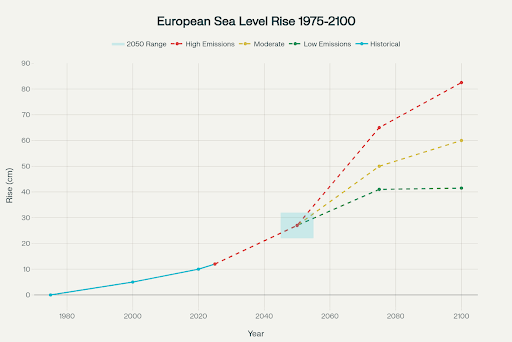
Sea level rise trends in Europe from 1975 to 2025 and projections through 2100 under different emissions scenarios.
Understanding the Trend
Europe’s sea level has been rising gradually but at an increasing pace. During the 20th century, sea levels rose by approximately 1.7 millimeters per year. By the 1990s, this rate had doubled to 3.3 millimeters annually, and between 2006 and 2018, it increased further to 3.7 millimeters annually. The primary causes are thermal expansion of warming water and melting glaciers and ice sheets.
Looking ahead, Europe will likely experience more than 10 centimeters of additional rise before 2050. By 2100, projections range considerably based on emissions scenarios. Under low-emissions scenarios, sea levels could rise by 28-55 centimeters. Under high emissions, the rise could reach 63-102 centimeters. Extreme sea levels from coastal storms are projected to increase by 34-76 centimeters under moderate scenarios. An important consideration is that this rise will continue for centuries regardless of emissions reductions achieved in the coming decades.
Financial and Community Impacts
The economic consequences of rising sea levels are substantial. Coastal flooding currently costs the EU approximately €1.2 billion annually. Without adaptation measures, this could increase to €137 billion per year under moderate emissions or €814 billion annually under high emissions by 2100, with approximately 3.9 million people exposed to regular flooding.
Major European cities face particular vulnerability. Milan, Paris, Frankfurt, Rotterdam, and Barcelona are projected to experience doubled damage costs by 2100 under high-emissions scenarios. Venice’s Veneto region could face regional income losses exceeding 20% without adaptation measures.
Foreseeing the inevitable, insurance markets are already adjusting to these risks. Germany experienced €2.6 billion in flood-related insurance claims in 2024, approximately €1 billion above its historical average. While France currently maintains subsidized premiums averaging €13 per household through its shared risk system, Italy’s coastal property insurance premiums rose 25% between 2017 and 2022.
Adaptation Strategies and Costs
European nations are implementing various protective measures with measurable costs and benefits. The average annual adaptation investment for the EU-27 is estimated at €1.1-€1.8 billion through 2100. Research indicates these investments could prevent approximately 95% of projected economic damages.
Infrastructure projects represent one approach. Venice’s MOSE flood barrier system consists of 78 mobile gates that rise from the seabed, and it cost €7 billion to construct. The system was designed to activate approximately five times annually, but has been deployed 97 times in its first four years of operation. Annual operational costs total nearly €20 million. Rotterdam’s port adaptation strategy cost €90 million and provides a benefit-cost ratio of 6.8, indicating substantial economic returns.
Nature-based solutions offer complementary benefits. Research shows 71% of nature-based solutions—including wetland and oyster reef restoration—prove cost-effective for disaster risk reduction, with benefit-cost ratios exceeding 3.5. These approaches provide both flood protection and environmental benefits at lower maintenance costs than traditional engineering.
Land Use Planning and Development Restrictions
Coastal development policies are increasingly restrictive in European nations. The Mediterranean Integrated Coastal Zone Management Protocol requires coastal setback zones—typically 100 meters from the highest winter waterline—where construction is prohibited or limited. Research indicates setback zones could reduce exposure of new urban development by at least 50% by 2100.
Spain implemented a coastal law in 1988 that established that property within 100 meters of the shore belongs to the public domain. Approximately 500,000 existing homes are located within this zone. Current regulations allow authorities to seize properties if waves reach them five times within five years.
Managed retreat—the planned relocation of settlements—has been implemented in limited locations. Austria successfully relocated over 500 households from flood-prone areas along the Danube, and France relocated a coastal road in its Mediterranean region. These processes typically require 10 or more years to complete and involve significant social and economic considerations. Many EU member states have not yet developed comprehensive managed retreat strategies.
Development Limits Going Forward
Scientific research supports strict limits on new coastal development in high-risk areas. Implementing setback zones based on both distance and elevation above sea level could reduce future urban exposure to coastal hazards by 46% by 2100. Experts note that the cost of protecting or maintaining coastal property will eventually become economically prohibitive, making prevention through development restrictions more cost-effective than emergency responses later.
Timeline and Implementation
Europe’s adaptation timeline extends from the present through 2100. Most protective infrastructure requires implementation between 2020 and 2050, followed by ongoing maintenance estimated at approximately 1% of capital costs annually. Nature-based solutions can be deployed relatively quickly but require years to reach full protective capacity.
The central reality is that sea-level rise is essentially locked in for centuries, regardless of near-term emissions reductions. This requires immediate action across multiple fronts: establishing strict coastal development restrictions in high-risk areas, investing in cost-effective protective measures, transitioning from emergency response to planned adaptation, and acknowledging that some degree of coastal retreat will ultimately be necessary. Delayed decision-making will increase adaptation costs and social disruption in the coming decades.
This Post was submitted by Climate Scorecard European Union Manager, Syaliza Mustapha.
Engagement Resources
- https://www.eea.europa.eu/en/analysis/indicators/global-and-european-sea-level-rise
- https://op.europa.eu/webpub/mare/eu-blue-economy-report-2025/energy-transition-and-costal-flood-impacts/climate-change-and-nature-based-solutions-against-coastal-floods-in-europe.html
- https://ieep.eu/wp-content/uploads/2022/12/Nature-based-solutions-and-their-socio-economic-benefits-for-Europes-recovery-IEEP-2021-WEB.pdf
- https://climate-adapt.eea.europa.eu/en/metadata/publications/special-report-managed-retreat-preparing-coastal-cities-for-sea-level-rise